A downstream service breaks immediately after a staging deployment. To identify the regression, you export the API response payloads from production and staging environments to compare them. Running diff -u prod.json staging.json outputs hundreds of mismatched lines. The underlying payloads contain identical data, but one serialiser sorted keys alphabetically while the other preserved insertion order. Furthermore, staging returned formatted indentation while production emitted minified text. A standard textual diff tool evaluates raw byte sequences and line terminators, meaning harmless formatting differences obscure genuine bugs.
Evaluating differences between JSON payloads requires structural comparison rather than raw string matching. To detect actual regressions—such as changed property values, missing attributes, or altered array elements—the comparison engine must parse the documents into abstract data types, normalise key ordering, and recursively evaluate nested branches. Without normalisation, the signal is lost in cosmetic noise, making it difficult to spot breaking schema updates, floating-point precision drifts, or unintended type coercions before they affect live users.
This guide demonstrates reliable approaches to comparing JSON documents across different engineering workflows. We examine how to configure command-line pipelines using jq paired with standard diff utilities, how to write deterministic structural comparison scripts in Python, and how to use client-side visual tools to inspect and analyse sensitive payloads without sending production data across third-party networks.
What is JSON Comparison and Why Structural Diffing Matters
Standard file comparison tools such as POSIX diff, git diff, and graphical merge tools operate line by line. They compute the longest common subsequence of text lines across two inputs. While effective for plain source code, this textual heuristic fails when applied to serialised JavaScript Object Notation (JSON).
JSON is an unordered collection of key-value pairs per RFC 8259. The specification explicitly states that the order of object keys carries no semantic meaning. In contrast, line-based text comparison treats line sequence as absolute truth. When an upstream API alters serialisation order or reformats whitespace indentation, a line-oriented diff utility reports complete file churn despite the payload data remaining identical.
Consider two payloads representing the same database record:
// payload_a.json
{
  "id": 1042,
  "status": "active",
  "tags": ["prod", "auth"]
}
// payload_b.json
{
"tags": ["prod", "auth"],
"id": 1042,
"status": "active"
}Running diff -u payload_a.json payload_b.json yields a false positive:
--- payload_a.json
+++ payload_b.json
@@ -1,5 +1,5 @@
 {
+  "tags": ["prod", "auth"],
   "id": 1042,
-  "status": "active",
-  "tags": ["prod", "auth"]
+  "status": "active"
 }
A standard text diff flags two line deletions and two line additions. In a production pipeline, this creates noise in deployment audits and breaks automated change-detection scripts.
Whitespace introduces further discrepancies. JSON allows arbitrary whitespace around structural tokens: characters 0x20 (space), 0x09 (tab), 0x0A (line feed), and 0x0D (carriage return). A single-line payload and a pretty-printed payload containing identical tokens will report zero matching lines under naive comparison.
Structural diffing—also known as semantic diffing—solves this problem by operating on the Abstract Syntax Tree (AST) rather than raw text. A semantic comparison engine parses both files into memory, normalises object keys, and resolves path coordinates before running an analysis.
| Diff Dimension | Line-Based Diff (diff, git diff) | Structural / Semantic Diff | | :--- | :--- | :--- | | Object Key Order | Order-sensitive; causes false positives | Order-agnostic; normalises key positions | | Whitespace & Indentation | Sensitive to spaces, tabs, and line endings | Discarded during AST tokenisation | | Array Elements | Line-by-line text matching | Ordered index comparison ([0], [1]) | | Data Types | Compares string representations | Differentiates true vs "true", 10 vs "10" | | Path Addressing | Outputs line numbers (e.g., line 42) | Outputs structural pointers (e.g., data.users[2].id) |
By isolating true semantic mutations—such as modified values, deleted properties, or array index shifts—structural comparison ensures that engineering teams analyse real state divergence rather than serialiser quirks.
Methods for Comparing JSON Payloads
Standard text comparison utilities treat JSON documents as arbitrary sequences of lines. This creates false positives whenever serialisers reorder object keys, adjust whitespace, or alter floating-point representations. Comparing payloads reliably across local development and automated deployment pipelines requires choosing a method suited to the execution environment.
1. Command-Line Normalisation and AST Diffing
For shell pipelines and local triage, pipe payloads through jq using the --sort-keys (-S) argument to canonicalise key ordering before passing streams to standard POSIX diff:
diff -u <(jq -S . payload-v1.json) <(jq -S . payload-v2.json)This approach addresses whitespace and key sorting, but fails on array semantics. Standard line-based diff tools evaluate array elements strictly by line position. If an upstream API returns an unindexed set in a non-deterministic order, diff reports false drift. Specialised CLI tools such as jd evaluate the abstract syntax tree directly and emit RFC 6902 JSON Patch operations (add, remove, replace), isolating genuine schema regressions.
2. Programmatic Engines for CI/CD Pipelines
Integration test suites require assertion logic that operates deterministically on memory buffers without invoking external shell processes. Standard equality assertions—such as Node.js assert.deepStrictEqual()—produce unreadable diffs when evaluating payloads exceeding several hundred keys.
Teams deploy programmatic libraries like Python's deepdiff or Node's jsondiffpatch. These libraries support custom equality rules, allowing pipelines to ignore timestamp fields, round floating-point variances, or evaluate array contents as unordered multisets:
from deepdiff import DeepDiff
diff = DeepDiff(payload_v1, payload_v2, ignore_order=True, significant_digits=4)
3. Visual Tree Comparators
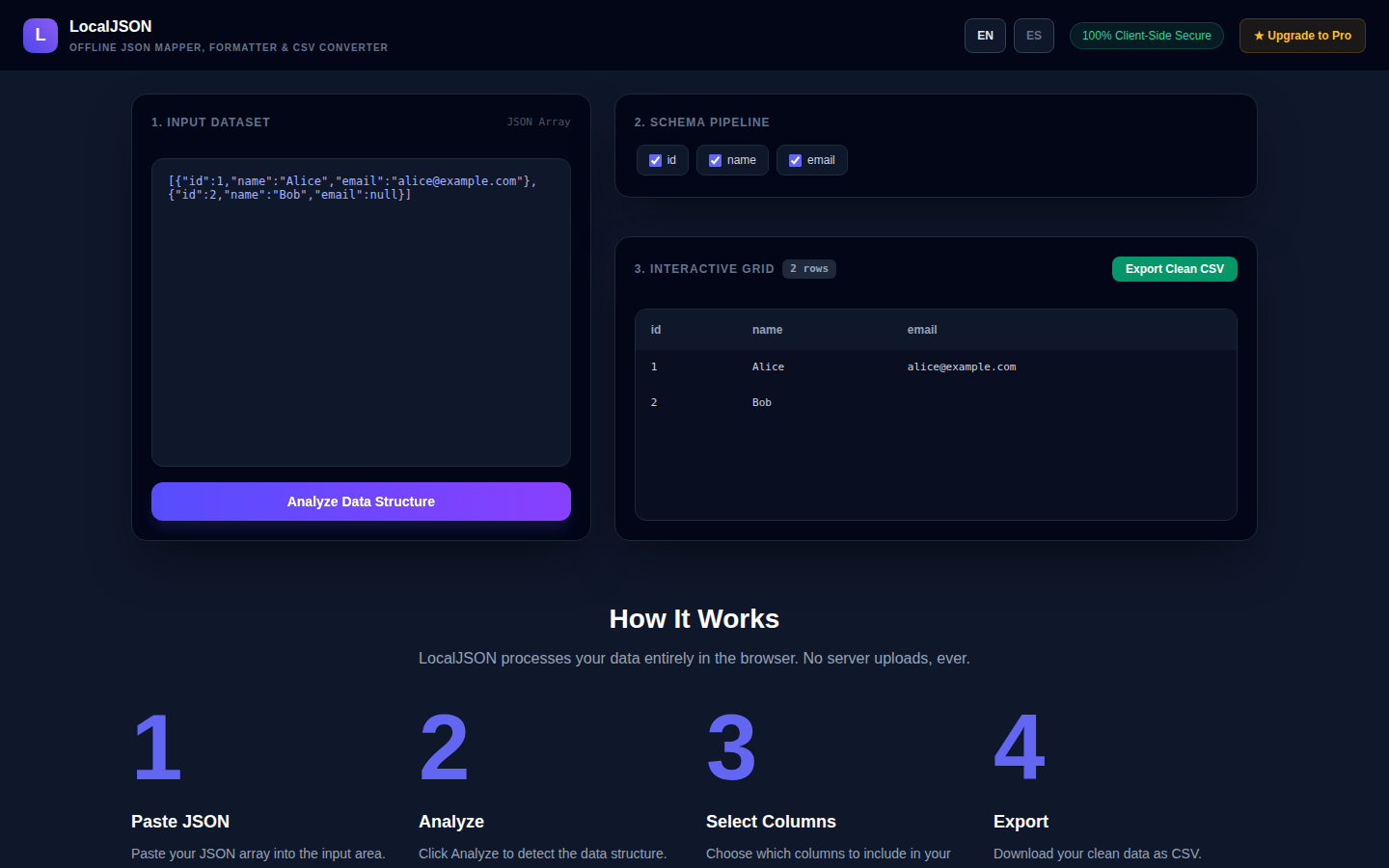
When debugging deeply nested schema drift or customer-reported payload mismatches, flat unified diffs become difficult to parse. Dedicated side-by-side graphical tools map objects to interactive tree structures. They fold unchanged branches, align matching sub-objects visually, and highlight scalar mutations inline without truncating long string values.
| Method | Key Order Agnostic | CI/CD Integration | Array Reordering | Output Format | | :--- | :--- | :--- | :--- | :--- | | jq -S + diff | Yes | High | Strict line index | Unified POSIX diff | | jd / AST CLI | Yes | High | RFC 6902 diff mode | JSON Patch / Native | | Programmatic | Yes | Native | Configurable sets | Structured object | | Visual Comparators | Yes | Low | Visual alignment | Dual-pane tree |
Common Pitfalls in JSON Diffing
Structural comparison of JSON documents exposes edge cases that plain-text diff tools cannot reconcile. When comparing serialised states across distributed microservices or differing runtimes, three technical hurdles routinely cause false-positive results or mask genuine regressions.
1. Array Ordering and Collection Semantics
RFC 8259 specifies that JSON arrays preserve element order. However, application-level payloads often use arrays to represent unordered collections, such as assigned permissions or database records fetched without an ORDER BY clause.
// Payload A
{"services": ["auth", "billing", "gateway"]}

// Payload B
{"services": ["billing", "gateway", "auth"]}
A positional comparison evaluates elements by index: index 0 ("auth" against "billing"), index 1 ("billing" against "gateway"), and index 2 ("gateway" against "auth"). Instead of identifying a permutation, naive diff engines report three distinct value substitutions. For arrays containing objects, the engine must identify a unique key (such as id or uuid) to correlate items rather than relying on sequential array offsets.
2. Floating-Point Numeric Precision
The JSON specification defines numbers as arbitrary sequences of digits without distinguishing integer from floating-point types. In practice, parsers cast numeric values to IEEE 754 64-bit binary floating-point numbers. Varying serialisation behaviours across runtimes create spurious diffs:
| Runtime / Library | Input Value | Serialised JSON | | :--- | :--- | :--- | | Python 3 (json.dumps) | float(1.0) | 1.0 | | Node.js (JSON.stringify) | 1.0 | 1 | | Go (encoding/json) | float64(1e-4) | 0.0001 | | Rust (serde_json) | 0.0001f64 | 0.0001 |
Without floating-point normalisation or an epsilon comparison threshold (such as $|a - b| \le 10^{-9}$), diff algorithms flag 1 and 1.0 as mismatched scalar values.
3. Explicit Null versus Omitted Keys
A key assigned a null literal is structurally present in the abstract syntax tree, whereas an omitted key does not exist. API serialisers often treat these states inconsistently:
// State A: Explicit null literal
{"transaction_id": "tx_901", "failure_reason": null}

// State B: Missing key
{"transaction_id": "tx_901"}
A strict diff categorises State B as removing "failure_reason", while State A is an addition. When schemas define fields as optional, your diff configuration must specify whether to strip null-valued keys before generating the structural delta.
Best Practices for Canonical Comparison
Direct text diffing tools such as GNU diff or git diff fail when serialisers output object keys in non-deterministic order. Because RFC 8259 specifies that object key ordering holds no semantic significance, two payloads with identical key-value mappings produce false-positive diffs if their keys are arranged differently. To prevent this, standardise both targets using recursive key sorting before running diff operations. If datasets contain unordered collections represented as arrays, specify an explicit unique identifier (such as id or uuid) to align elements prior to evaluation.
function canonicalise(value) {
  if (value === null || typeof value !== 'object') {
    return value;
  }
  if (Array.isArray(value)) {
    return value.map(canonicalise);
  }
  return Object.keys(value)
    .sort()
    .reduce((sorted, key) => {
      sorted[key] = canonicalise(value[key]);
      return sorted;
    }, {});
}
Beyond raw key-value sorting, comparison pipelines require schema awareness. Numeric precision discrepancies often introduce false modifications: for example, float representations like 1.0 and integer 1 parse identically in some environments but diverge in textual representations. Establish comparison rules that parse numeric literals into standard types according to an agreed JSON Schema before generating deltas. When diffing arrays of objects, standard line diffing misaligns collections if items are reordered. Enforce array-matching strategies by hashing unique identifier attributes, ensuring the diff engine compares records based on identity rather than array index position.
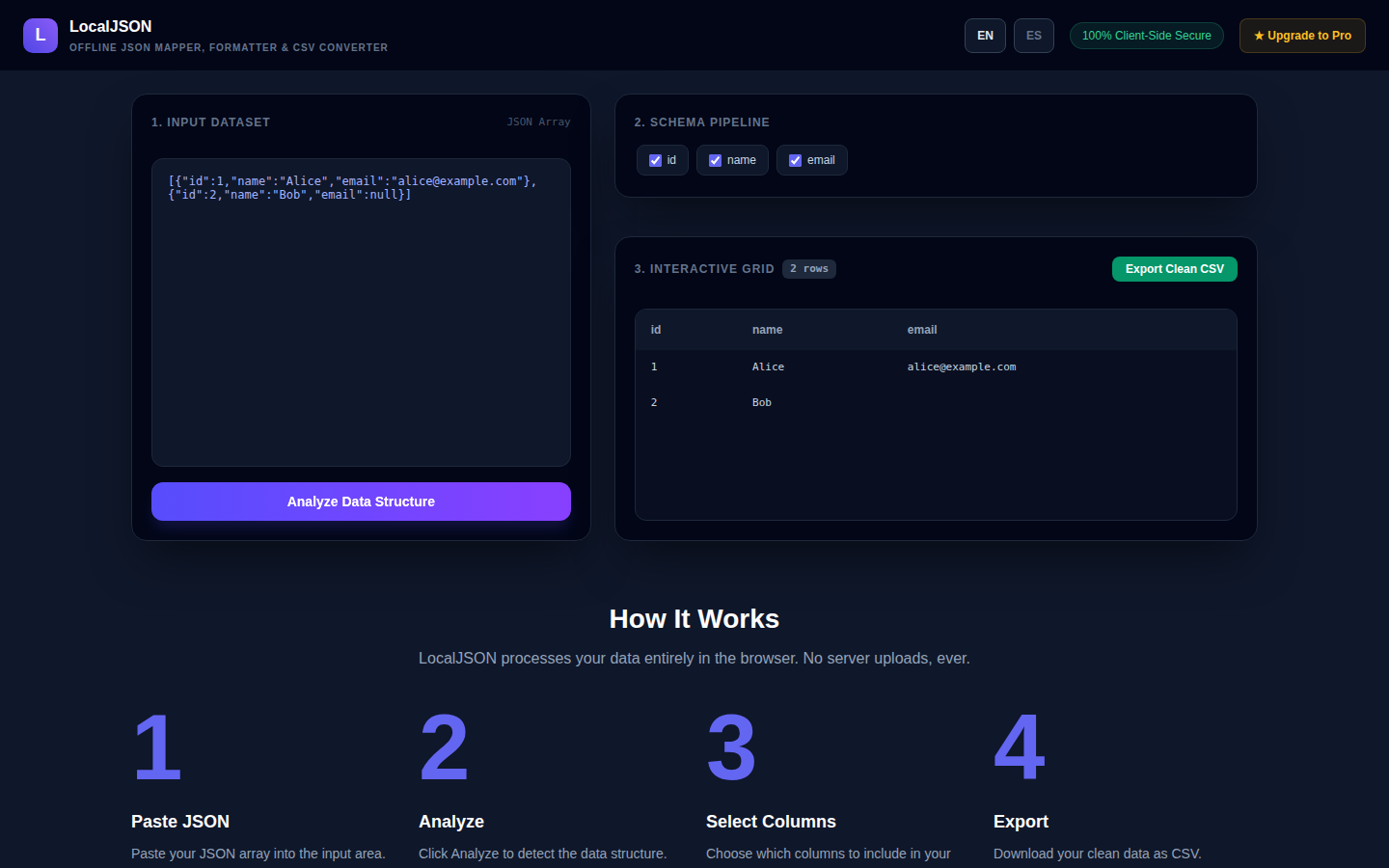
Diagnostic payloads frequently contain sensitive production data, including personally identifiable information (PII), authentication tokens, and internal network traces. Routing these datasets through remote web APIs for formatting or comparison introduces compliance and exfiltration risks under regulations such as GDPR. Adopt client-side processing workflows where comparison operations execute strictly inside browser memory using the WebAssembly or JavaScript runtime. Local processing guarantees that zero bytes leave the workstation, satisfying security boundaries while maintaining execution speeds independent of network latency. For automated CI/CD checks, implement identical offline scripts locally to catch regressions before serialising artifacts to storage.
Conclusion
Choosing the correct JSON comparison strategy requires balancing syntactic representation against semantic meaning. Line-based comparison tools such as GNU diff, git diff, or standard POSIX utilities operate strictly on byte streams and newline delimiters. They execute with minimal memory overhead in $O(N)$ time, making them suitable for multi-gigabyte files. However, line diffs generate false positives when keys are reordered, indentation changes, or strings contain escaped line breaks. Semantic diffing parses documents into an abstract syntax tree (AST), traversing key-value pairs independently of lexical formatting.
| Criterion | Line-Based (diff -u) | Semantic CLI (jd, diff-json) | Client-Side Engine | | :--- | :--- | :--- | :--- | | Key Order Sensitivity | Strict (emits false diffs) | Insensitive (normalised tree traversal) | Insensitive | | Array Matching | Positional by line | Positional by index / set equivalence | Keyed or indexed | | Memory Complexity | $O(1)$ streaming buffer | $O(N)$ heap allocation | $O(N)$ browser memory | | Throughput Limit | I/O-bound (multi-gigabyte) | Heap-bound (~500 MB max JSON) | V8 limit (~150 MB payload) | | Privacy Risk | Zero (local POSIX process) | Zero (local container / script) | Zero (sandboxed client-side) |
Data volume and execution context impose strict technical trade-offs. In automated CI/CD pipelines, semantic diff tools provide deterministic exit codes without failing on harmless key reshuffling. However, because semantic parsers build in-memory object graphs, they encounter memory exhaustion when inspecting files exceeding runtime heap ceilings. In V8 and Node.js runtimes, parsing a 200 MB JSON string can allocate over 800 MB of heap memory. When handling files beyond these limits, normalise the inputs using a streaming sorter (jq -S . input.json) before piping the output into line-based comparison tools.
Privacy governance dictates tool selection when inspecting proprietary payloads. Production data containing personal identity information, regulated financial records, or internal API tokens must remain strictly within audited boundaries. Remote web-based diff utilities introduce data exfiltration risks by transmitting payloads across external networks. For interactive troubleshooting without command-line dependencies, private browser-based utilities like LocalJSON parse, format, and compare structures entirely client-side. Align the diffing strategy to the operational requirement: use line-based streaming for bulk log data, semantic CLI parsers for regression pipelines, and secure local engines for visual payload inspection.