Every engineer integrating third-party APIs encounters the same operational friction: vendor payloads rarely align with internal domain models. A payment provider might export transaction records with abbreviated snake_case keys, deeply nested address structures, and empty strings for absent identifiers. Meanwhile, your production database expects camelCase naming conventions, flattened scalar fields, and integer Unix epoch timestamps. Reconciling these structural differences by writing ad-hoc mutation code inside webhooks or ingest workers introduces fragile maintenance overhead and breaks whenever upstream providers alter undocumented properties.
Schema mapping is the process of translating external semi-structured payloads into verified internal data contracts before database persistence or downstream analytical processing. Treating incoming JSON as untrusted input requires systematic extraction, key renaming, structural flattening, type coercion, and defensive defaulting. When handled incorrectly, edge cases such as null nested objects, irregular array wrappers, and divergent ISO 8601 date formats trigger unhandled exceptions or corrupt data pipelines.
This guide examines how to map vendor JSON to your required target schema predictably and reliably. We will evaluate three practical approaches: declarative stream filtering with command-line tools like jq, typed model validation using Python and Pydantic, and browser-based transformation utilities for ad-hoc exports. We also cover practical techniques for handling missing keys, managing structural divergence, and preventing silent ingestion failures.
What is Vendor JSON Mapping and Why Use It
Integrating third-party APIs forces applications to ingest schemas designed around an external provider's operational domain rather than your internal architecture. A payment gateway, an enterprise ERP, or a CRM models data according to its own entity relationships, nomenclature, and serialisation rules. Vendor JSON mapping is the deterministic translation of these disparate payload structures into a validated, domain-specific internal schema prior to database persistence or event routing.
When upstream services emit payloads that directly populate downstream data stores, architectural degradation occurs quickly. Direct ingestion tightly couples internal business logic to external API contracts, exposing your systems to breaking changes whenever a provider updates an endpoint, deprecates a property, or alters default field types.
Structural and semantic discrepancies typically fall into four distinct categories:
| Discrepancy Category | Upstream Vendor Structure | Internal Domain Requirement | Engineering Impact | | :--- | :--- | :--- | :--- | | Key Casing & Taxonomy | cust_ref_no, BILLING_ADDR | customerId, billingAddress | Syntax errors across strict typing contracts | | Temporal Representation | Epoch timestamp (1711972800) | ISO-8601 string ("2024-04-01T12:00:00Z") | Timezone drift and parsing failures | | Monetary Precision | Float values (19.99) | Integer cents or pence (1999) | IEEE 754 floating-point rounding errors | | Hierarchy Flattening | Deep object graph (payload.v2.order.items[0]) | Flat relational foreign key record | Inefficient unmarshalling and nested query overhead |
Consider a concrete example where an e-commerce platform emits a raw dispatch notification that must update a fulfillment database:
{
  "order_ref": "ORD-94812",
  "dispatch_epoch": 1711972800,
  "recipient": {
    "full_name": "Jane Doe",
    "delivery": { "iso_country": "GB", "postal_code": "EC1A 1BB" }
  },
  "line_items": [
    { "sku_id": "SKU-441", "unit_price": "42.50", "qty": 2 }
  ]
}
Persisting this document directly introduces technical debt. The currency arrives as an arbitrary string instead of minor-unit integers, the timestamp lacks explicit timezone context, and address metadata is nested two levels deep.
Deterministic mapping acts as an anti-corruption layer. The transformation process enforces strict schema validation, strips superfluous metadata, normalises disparate null states (such as converting empty strings or missing properties to explicit null values), and guarantees that internal services consume predictable invariants regardless of upstream volatility.
Three Methods for Mapping Vendor Payloads
Integrating upstream vendor payloads into an internal canonical schema requires transforming inconsistent keys, handling divergent types, and reshaping nested records. Teams typically use three approaches depending on execution context, data volume, and regulatory constraints.
1. Stream Filtering with jq
For pipeline automation, shell scripts, or CI/CD tasks, jq is the standard tool. It executes memory-efficient streaming transformations without runtime dependencies. Consider a vendor payload delivering contact information under non-standard keys:
# Input: {"vendor_user_id": 4821, "meta": {"contact_email": "ops@example.co.uk"}}
jq '{ id: .vendor_user_id, email: .meta.contact_email, active: true }' vendor.json
While jq handles straightforward key renames and unnesting efficiently, complex mapping logic—such as parsing irregular timestamps, conditional fallback chains, or nested arrays—quickly produces brittle, difficult-to-maintain expressions.
2. Bespoke Python Scripts
When mappings demand arithmetic normalisation, external validation, or multi-field conditional branches, an explicit Python script using standard dictionaries or Pydantic models provides predictability:
import json

def map_vendor_record(raw: dict) -> dict:
    return {
        "account_id": f"VND-{raw['vendor_user_id']}",
        "primary_email": raw.get("meta", {}).get("contact_email", "").strip().lower(),
        "status": "active" if raw.get("status_code") == 200 else "suspended"
    }
Python handles nuanced business rules cleanly and integrates with automated testing suites. However, developing, testing, and packaging bespoke scripts introduces maintenance overhead for ad-hoc payload analysis or immediate triage of downstream breaking changes.
3. Client-Side Transformation Utilities
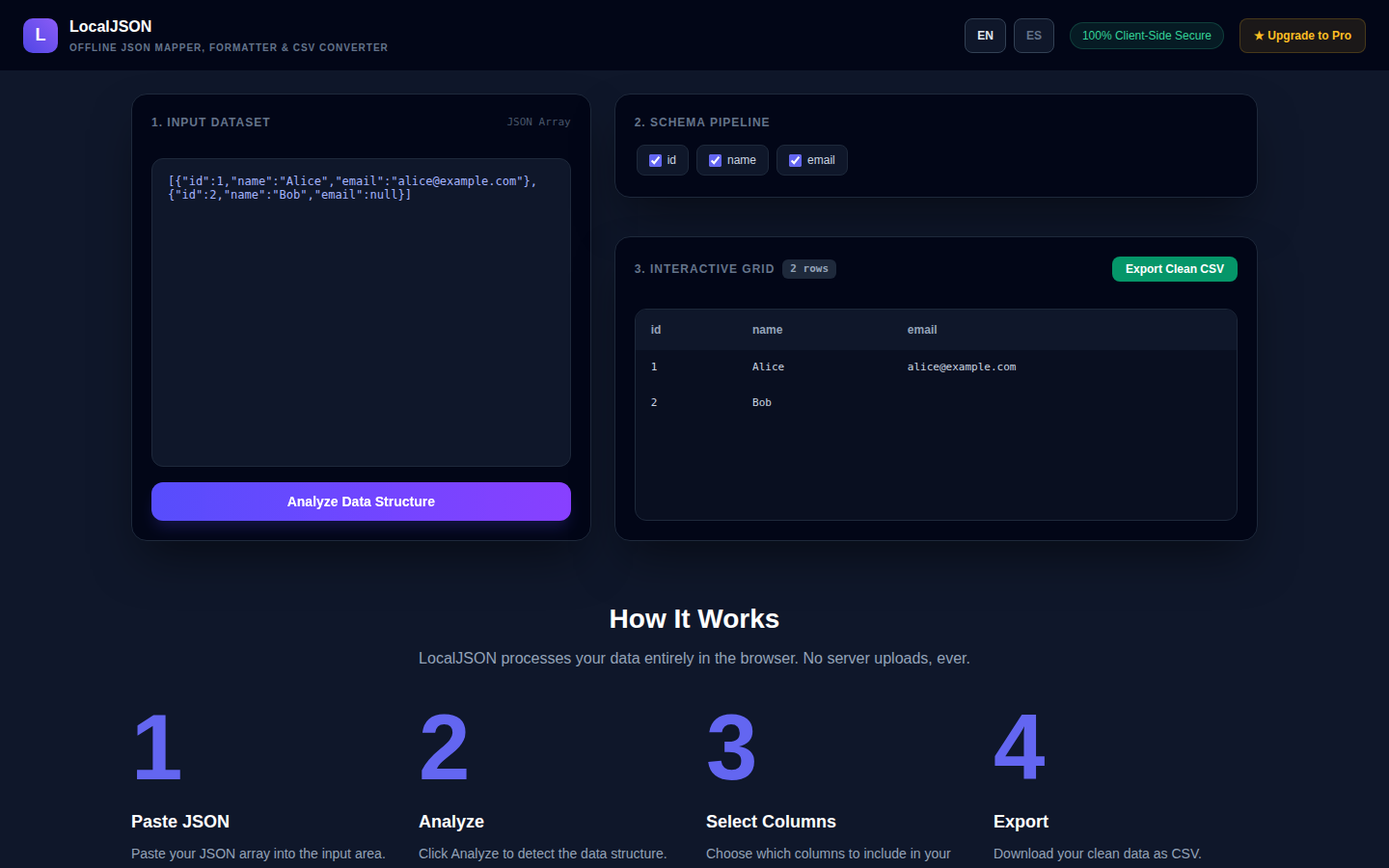
When reviewing raw batch extracts or testing structural hypotheses, running scripts or transmitting payloads to third-party web endpoints introduces operational friction and security risks. In-browser utilities execute schema adjustments directly within the browser engine via local JavaScript runtimes.
This client-side execution ensures sensitive vendor data never leaves your workstation, complying with strict data residency rules. Engineers can inspect structural hierarchies, isolate differing fields, and flatten records into normalised shapes before writing persistent ingestion code.
| Approach | Execution Context | Implementation Overhead | Logic Complexity | Best For | | :--- | :--- | :--- | :--- | :--- | | jq | Terminal / POSIX shell | Minimal (single CLI call) | Low to moderate | Shell pipelines, fast batch renaming | | Python | Local script / worker | Moderate (runtime & tests) | High | Complex validation, conditional business rules | | Client-Side Utility | Local browser engine | None (instant GUI execution) | Moderate | Ad-hoc triage, flattening, privacy-sensitive audits |
Common Schema Mapping Pitfalls
Runtime mapping pipelines fail most frequently at boundary conditions where vendor data deviates from documented specifications. Three issues account for the majority of deserialisation and validation exceptions in production: inconsistent null semantics, structural nesting changes, and conflicting date-time representations.
Inconsistent Null and Empty Representations
Vendors rarely maintain consistent semantics for missing or non-applicable values. A single API may express the absence of an identifier using four distinct patterns across different endpoints or webhook payloads:
{
  "event_a": { "account_id": null },
  "event_b": {},
  "event_c": { "account_id": "" },
  "event_d": { "account_id": "null" }
}
If your target schema requires an optional UUID (UUID | null), standard parsers fail on event_c and event_d. Parsing "" into a UUID or integer column produces a runtime database constraint error, whilst "null" introduces corrupted string literals into downstream storage. Mapping routines must explicitly normalise empty strings, the literal string "null", and missing properties into a single canonical null before schema validation executes.
Structural Nesting and Polymorphic Keys
Vendor schema revisions often move flat keys into nested objects. For instance, migrating from a flat shipping_postal_code to shipping.address.postcode. Direct property paths such as payload.shipping.address.postcode fail with an unhandled TypeError when an upstream service emits a legacy payload, a partial webhook, or an error response where shipping evaluates to null.
Polymorphic payloads compound this issue. An endpoint might return metadata as a key-value object ({"tier": "standard"}) on populated records, but emit an empty JSON array ([]) or a string when uninitialised. A mapper that assumes an object structure fails immediately when calling Object.keys() or when traversing child keys on array instances.
Temporal Precision and Offset Mismatches
Date-time values exhibit recurring formatting drift across vendor versions. A mapping layer must handle variations in serialisation formats, epoch units, and timezone declarations:
| Vendor Representation | Example | Parser Risk | Target Standard | | :--- | :--- | :--- | :--- | | Unix Epoch (seconds) | 1760443200 | Misparsed as 1970 if milliseconds expected | 2025-10-14T12:00:00.000Z | | Unix Epoch (ms) | 1760443200000 | Integer overflow in 32-bit runtimes | 2025-10-14T12:00:00.000Z | | Naive Datetime | "2025-10-14 12:00:00" | Parsed using host system local timezone | 2025-10-14T12:00:00.000Z | | Custom Vendor Format | "14/10/2025 12:00:00 PM" | Locale-dependent day/month swapping | 2025-10-14T12:00:00.000Z |
When timestamps omit an explicit UTC offset (Z or +00:00), parser behaviour depends on host server configuration, silently shifting values across different runtime environments.
Best Practices for Reliable Schema Transformation
Third-party APIs frequently alter payload structures without incrementing version numbers or providing deprecation notices. Treating external JSON as untrusted input requires defensive transformation patterns that isolate mapping logic from downstream services.
Validate Boundaries with JSON Schema
Validate incoming payloads before transformation and target payloads immediately after. A pre-transformation schema checks that required source keys exist and conform to expected primitive types. A post-transformation schema verifies that the output strictly satisfies your internal domain model.
from decimal import Decimal, InvalidOperation
import jsonschema

TARGET_SCHEMA = {
    "type": "object",
    "required": ["order_id", "total_cents", "currency"],
    "properties": {
        "order_id": {"type": "string", "pattern": "^ord_[0-9a-f]{8}{{BODY}}quot;},
        "total_cents": {"type": "integer", "minimum": 0},
        "currency": {"type": "string", "minLength": 3, "maxLength": 3},
    },
    "additionalProperties": False,
}

def coerce_amount_to_cents(value: str | float | int) -> int:
    try:
        dec = Decimal(str(value))
        return int((dec * 100).to_integral_value())
    except (InvalidOperation, TypeError, ValueError) as err:
        raise ValueError(f"Invalid monetary value: {value}") from err

def transform_vendor_order(raw: dict) -> dict:
    mapped = {
        "order_id": f"ord_{raw['id']}",
        "total_cents": coerce_amount_to_cents(raw["charge"]["amount"]),
        "currency": str(raw["charge"].get("cur", "GBP")).upper(),
    }
    jsonschema.validate(instance=mapped, schema=TARGET_SCHEMA)
    return mapped
Apply Deterministic Type Coercion
Vendor APIs often serialise numeric fields as strings (for example, "amount": "19.99") or alternate between null, [], and omitted keys for empty collections. Implement strict coercion functions instead of relying on implicit runtime casting:
| Source Value | Naive Cast (int(v) / bool(v)) | Defensive Target Behaviour | | :--- | :--- | :--- | | "12.00" | ValueError | Parse to Decimal, convert to integer cents | | "false" | True (non-empty string) | Strict string comparison: v.lower() == "true" | | null (list) | TypeError on iteration | Default to empty array [] | | "" (date) | Invalid datetime parse | Normalize to None if optional; fail otherwise |
Maintain Fixture-Based Regression Suites
Maintain a test suite containing frozen vendor JSON payloads representing nominal cases, legacy variants, and recorded production edge cases. When updating mapping logic, execute your transformations across all fixtures and verify the output structure. If an upstream integration changes, capture the raw payload and use structural comparison techniques—as outlined in Comparing JSON Files: A Practical Guide—to isolate modified, renamed, or omitted fields before modifying transformation code.
Conclusion
Choosing an architectural pattern for vendor JSON transformation depends on payload variability, ingestion frequency, and team composition. Hand-coded transformation pipelines—whether written in Python using dataclasses or Node.js via TypeScript type guards—offer complete runtime flexibility. However, procedural mapping scripts tightly couple vendor-specific quirks directly into application logic. When an upstream API alters nesting or replaces a null field with an empty string, procedural updates require unit test revisions, code reviews, and container redeployments.
Declarative configurations and dedicated mapping tools decouple transformation rules from underlying compute engines. Storing mappings as static specifications (such as JSON-to-JSON path declarations or JSONata expressions) isolates ingestion adapters from core domain logic.
| Architectural Dimension | Procedural Scripts (Python / Go) | Declarative DSL / Dedicated Tools | | :--- | :--- | :--- | | Schema Drift Handling | Hard failures unless defensive fallbacks are written per field | Declarative config updates without application rebuilds | | Transformation Latency | Sub-millisecond (compiled or native VM execution) | Small overhead (~2–15 ms AST evaluation) | | Auditability | Embedded in git commits across repository files | Isolated field-mapping matrices or JSON tables | | Downstream Export | Requires custom serialisers (e.g., CSV formatters) | Built-in exporters conforming to RFC 4180 | | Failure Boundary | Unhandled exceptions risk crashing the worker process | Payload rejected to dead-letter queue via schema check |
A resilient ingestion architecture treats vendor JSON as untrusted input. Always enforce an explicit boundary: ingest the raw document into object storage, validate its shape against a contractual schema, and apply transformations into an internal canonical model before passing records to internal consumers. If upstream vendors alter schemas unexpectedly, analysing payload structural diffs with Comparing JSON Files: A Practical Guide pinpoints added, omitted, or mutated fields before pipelines halt.
For one-off transformations, batch migrations, or rapid debugging where deploying an ingestion worker introduces unnecessary overhead, a client-side utility like LocalJSON provides an immediate feedback loop. By verifying mappings locally in the browser without transmitting proprietary vendor records over third-party networks, engineers can prototype declarative mappings, extract structural tabular records, and export clean datasets without operational overhead.